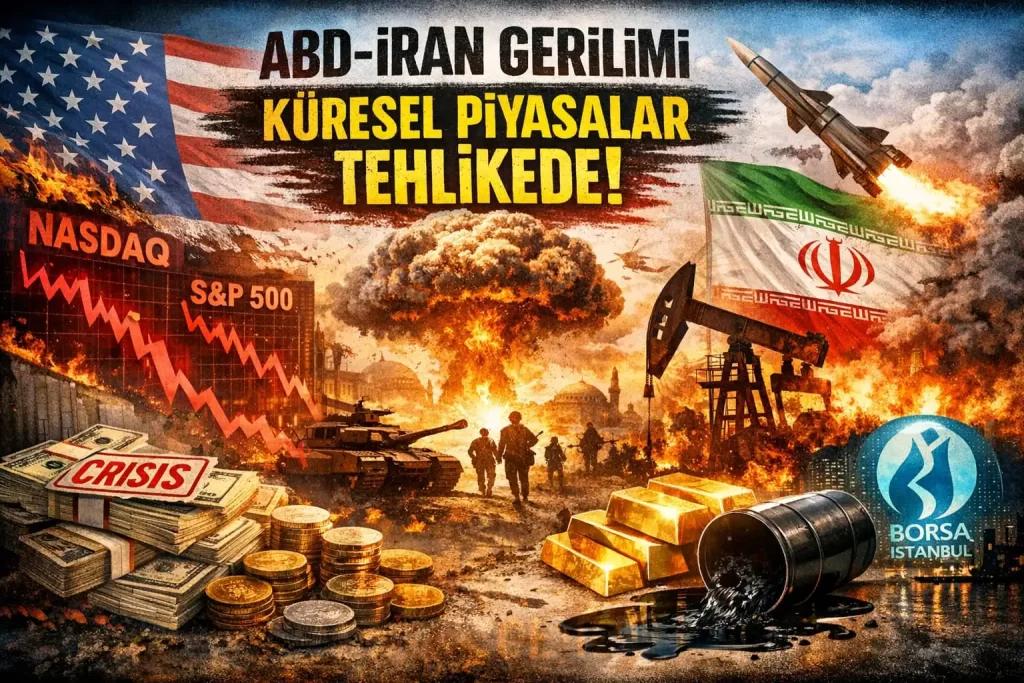
We are entering a period in financial markets where price is an illusion and liquidity is the only reality. 2026 will be the year we pay the price for this mistake. The decline in liquidity momentum that I have been pointing out since September, now combined with the US-Iran crisis, is pushing markets into a liquidation process. Beyond a technical correction, we are facing a situation where the lack of liquidity is fueled by geopolitical risk.
Nasdaq and S&P 500: Eliminating Valuation Multiples
The biggest misconception is that investors focus solely on company profits. When liquidity taps are tightened, the valuation multiples the market assigns to companies fall rapidly. This is the main fuel for the collapse I expect in American indices. Since I don’t expect a regional ground war, the direct impact of the crisis on prices will be limited. However, the real danger is that this tension will further suppress already dried-up liquidity. In other words, the lasting damage to the market will be caused not by the war itself, but by the liquidity drought.
Gold and Silver: The Straw Fire Scenario
Although demand for gold increases during wartime, any rise without liquidity support is fleeting. During the Russia-Ukraine war at the beginning of 2022, gold reached a new peak, but due to a lack of liquidity support, it quickly retreated to the 1600s. Today, unless the US-Iran crisis escalates into a full-scale ground war, gold is not a means of enrichment, but merely a temporary insurance policy. Since liquidity does not support these levels, prices will return to their starting point just as quickly. In the silver market, this tension will only be used as a pretext for commodity distribution.
Oil: The Market’s Inflation Bomb
Because oil remains relatively cheap among commodities, it is the instrument that will most dramatically reflect US-Iran tensions in its price. Threats over the Strait of Hormuz rapidly drive oil prices up, creating a vicious cycle that fuels global inflation and further reduces liquidity. In other words, every jump in oil prices will further erode the liquidity that stock markets need. Depending on the future of the war, prices could move into much more aggressive ranges.
Istanbul Stock Exchange: From Shock to Strategic Oasis
The risk of war and military activity in our immediate vicinity will initially negatively impact the Istanbul Stock Exchange. However, this shock holds a great opportunity in the medium term. The strategic need the US will feel for Turkey during this crisis, and Ankara’s balancing act, will open a new door for foreign capital. The Istanbul Stock Exchange, which remains undervalued compared to global stock exchanges, will become the center where global capital flows most eagerly, thanks to the limited impact of liquidity and our strategic location.
Ambush and Strategic Positioning
2026 is not a year for increasing capital, but a year for preserving capital. My strategy is clear: Initially, remain cash-heavy and wait for the market to overcome this liquidity and war shock. The short-term pullback I expect in the Istanbul Stock Exchange is actually a cleansing process preparing the ground for a major rise in the medium and long term. The wind has changed direction; either you adjust your sails to the new reality, or you go down in history as a victim swallowed by the storm.
About the Author