The ‘Carbon Peaking and Carbon Neutrality China’s Plans and Solutions’ White Paper published by the State Council Information Office of China in November presented China’s carbon dioxide emissions over the past five years and its key decisions, approaches, actions, and important decisions toward achieving carbon neutrality. The introduction to the White Paper emphasized that China has always fulfilled its commitments, adhering to the principle that clear waters and lush mountains are invaluable assets, and has achieved historic results in advancing the green and low-carbon transition through concrete actions and painstaking efforts. The main highlights of the White Paper are as follows:
The Rapid Development of Non-Fossil Energy
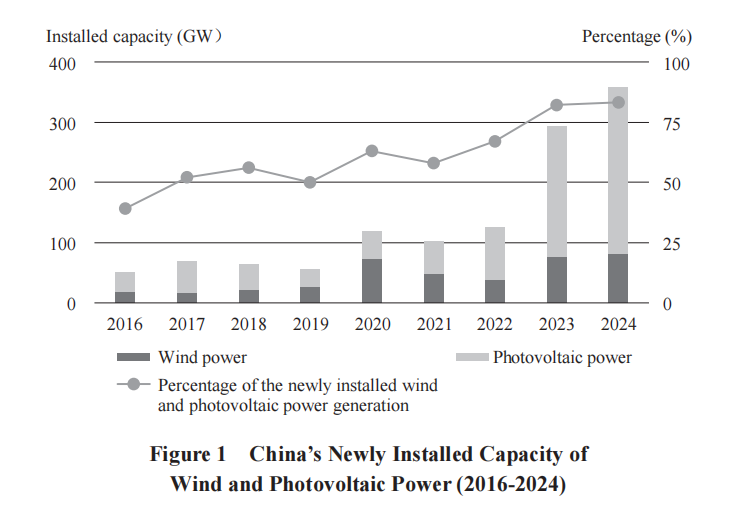
China has achieved the largest scale and fastest pace of new energy development in the world. The non-fossil energy consumption ratio rose from 16.0% in 2020 to 19.8% in 2024.
It is strongly developing wind and photovoltaic energy. China attaches importance to both centralized and distributed energy production. It actively promotes the construction of large-scale wind and photovoltaic power plants in barren and rocky areas and deserts, continuously develops offshore wind farms, actively supports rooftop photovoltaic power generation in urban and rural areas, and encourages distributed wind power generation in rural areas. By the end of August 2025, the installed capacity of wind and photovoltaic energy exceeded 1,690 GW, tripling the 2020 level and accounting for approximately 80% of the new power generation capacity installed since 2020. The share of wind and photovoltaic energy is steadily increasing at an average annual rate of 2.2%.
As of the end of August 2025, China’s installed hydroelectric capacity is approximately 380 GW, while the capacity of pumped storage hydroelectric power plants is approximately 62.37 GW. As of the end of August 2025, China has 112 nuclear power plants with an installed capacity of 125 GW that are in operation, under construction, or approved for construction, ranking first globally. As of the end of 2024, China was the world leader in annual green hydrogen energy production capacity (over 150,000 tons). China has diversified the exploration and use of biomass energy in accordance with local conditions. It is steadily advancing electricity generation from agricultural and forestry biomass, biogas, and municipal solid waste incineration. It also promotes the use of biomass energy for clean heating and the use of clean liquid fuels such as bioethanol and biodiesel. By the end of August 2025, installed biomass energy production capacity reached 46.88 GW, a 60% increase compared to 2020. China has also constructed a series of central heating projects powered by geothermal energy. It also supports pilot projects to harness ocean energy, such as tidal and wave energy. Progress has been made in the large-scale use of ocean energy.
Accelerating the Clean and Efficient Use of Fossil Energy
China has continued to improve the clean and efficient use of fossil energy and rationally control its consumption. The proportion of fossil energy consumed fell from 84% in 2020 to 80.2% in 2024.
China has made steady progress in coal supply and coordinated low-carbon transition. It has intensified efforts to develop environmentally friendly and smart mines and reduce carbon emissions in the mining process. Measures have been taken to achieve energy savings and low-carbon transformation in coal-fired power units and to phase out old production capacity in the coal-fired power sector. China has also intensified its efforts to reduce coal consumption in key industries and sectors and replace it with alternative energy sources. It is increasing the share of clean energy and the electrification rate in the industrial sector and steadily replacing bulk coal with clean energy. China’s coal share in total energy consumption fell from 56.7% in 2020 to 53.2% in 2024.
Faster Improvement in Clean and Low-Carbon Transportation
China is promoting the development of low-carbon transportation vehicles and equipment, gradually optimizing its transportation structure, and accelerating efforts to establish a comprehensive modern transportation system that is safe, comfortable, efficient, green, and economical.
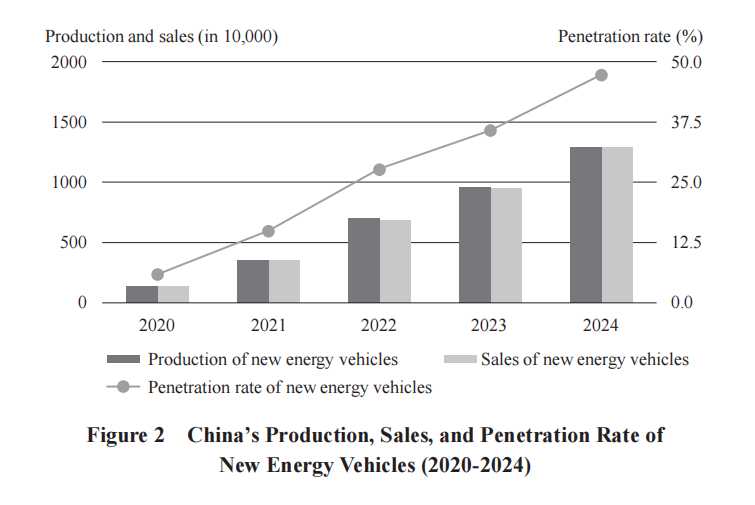
In the January-September 2025 period, the penetration rate of new energy passenger vehicles in the domestic market reached 52.2%, ranking first among major economies. China is a world leader in railway electrification, with an electrification rate reaching 76.2% in 2024. China has promoted the use of clean energy in ships and aircraft. By 2024, the fuel consumption per ton/km of the civil aviation fleet has decreased by 20.5% compared to 2005. China has further expanded the use of shore power for ships at anchor in key areas and on key routes. More than 90% of dedicated berths in China’s major ports have access to shore power. China’s civil aviation airports are global leaders in electrification. As of the end of July 2025, 32% of all vehicles at China’s civil aviation airports are electric vehicles.
In 2024, the total turnover of rail freight transport will be 13. Compared to the end of the Fifth Five-Year Plan period (2016-2020), it will increase by 17.5%, while the turnover of waterway freight transport increased by 33.6%, and the green transfer of coal and iron ore (by rail, waterway, closed belt conveyor, and new energy vehicles) at major coastal ports reached 88.4%.
By the end of August 2025, the total number of charging facilities for electric vehicles in China reached approximately 17.35 million, a tenfold increase in five years. China has emphasized its strategy of prioritizing public transportation in urban areas and accelerated the construction of a green transportation system. By the end of June 2025, China had become the world leader in urban rail transit with 330 lines and a total rail length of over 11,000 km.
Optimization of the waste recycling management system
China has introduced targeted policies and measures for the management of waste from various sources and continues to develop its waste recycling system to achieve precise management and effective recycling. By the end of 2024, there will be approximately 150,000 collection points and approximately 1,800 large-scale sorting centers of various types across the country.
Steady improvement in waste utilization
China has implemented policies specific to different types of waste to facilitate the standardized, large-scale, and clean use of renewable resources. To date, approximately 100 recycling centers have been built nationwide for the comprehensive utilization of municipal solid waste. In 2024, more than 400 million tons of important renewable resources, including scrap iron and steel, non-ferrous metals, paper, rubber, and glass, were reused. A total of 8.46 million scrap vehicles and 630,000 tons of waste household appliances have been recycled in a standardized manner. This corresponds to an annual increase of 64% and 20%, respectively. China also provides strong support to the remanufacturing industry, which reached a production value exceeding 200 billion RMB in 2024 alone.
Deeper South-South cooperation in combating climate change
China supports other developing countries in enhancing their capacity to respond to climate change through a holistic approach that integrates green vision, green technology, and clean energy. Since 2016, it has provided and mobilized 177 billion RMB in project funding for this purpose. As of the end of October 2025, China has signed 55 memoranda of understanding with 43 developing countries on South-South cooperation in combating climate change and organized more than 300 capacity-building programs.
China has launched international science and technology innovation cooperation plans and established regional international low-carbon organizations and international cooperation platforms for green and low-carbon technology. As of the end of October 2025, China has established science and technology cooperation with more than 160 countries and regions, signed 120 intergovernmental agreements on science and technology cooperation, and participated in more than 200 international organizations and multilateral mechanisms in this field.
You can view the entire White Paper here.
About the Author