Türkiye is a key country along the Belt and Road Initiative (BRI) and a major country with important influence in the Middle East. In 2010, China and Türkiye established a ‘Strategic Cooperation‘ relationship, which marks an important escalation of relations between the two countries. In 2015, Türkiye became one of the first countries in the world to sign an intergovernmental cooperation agreement on the BRI with China. The year 2025 coincides with the 15th anniversary of the establishment of strategic cooperative relations between China and Türkiye. Over the years, China-Türkiye relations have been flourishing in political, economic, cultural and other fields.
Four stages of strategic partnership development
From 2010 to the present, the development of China-Türkiye relations can be roughly divided into four phases. The first phase was from the establishment of a strategic partnership in 2010 to the military coup attempt in July 2016. The main feature of China-Türkiye relations at this stage was “two steps forward and one step back.” Some Turkish scholars believe that the development of China-Türkiye relations at this stage is more driven by China, and because of the misperceptions of China, the Turkish side is not active enough.
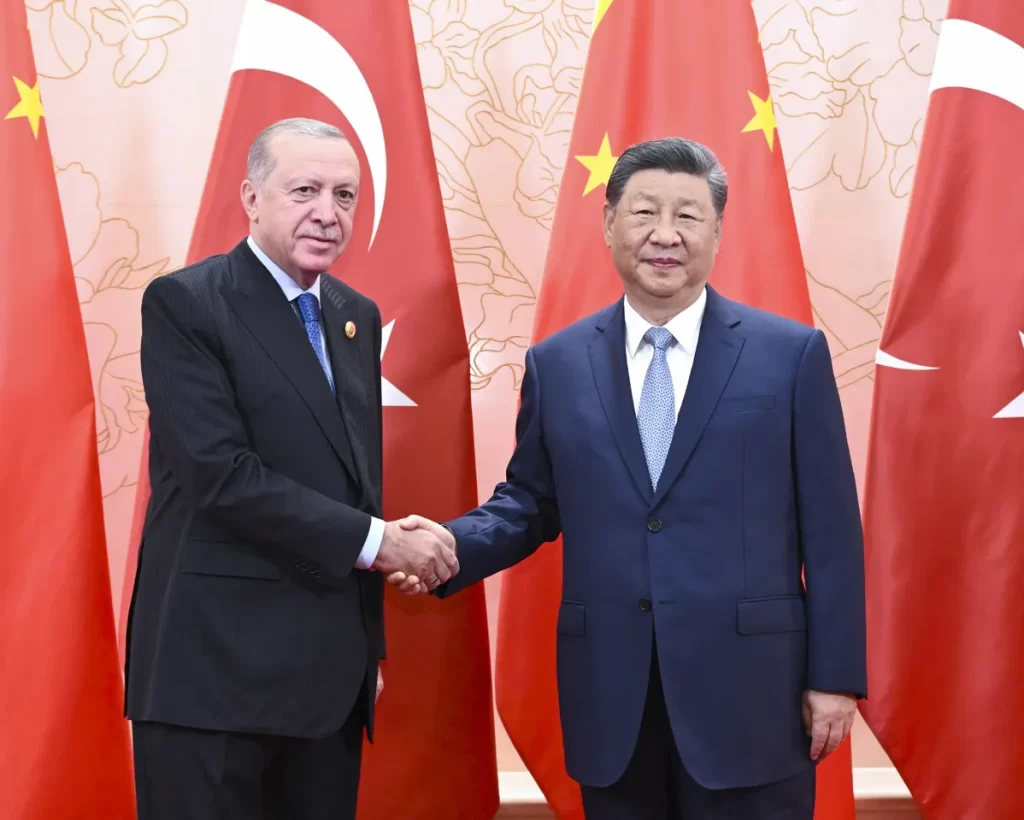
The second phase is from July 2016 to February 2019. The main characteristic of this stage is believed to be “the friendship between suffering and truth.” In August 2016, Chinese Vice Foreign Minister Zhang Ming visited Türkiye. In Türkiye’s view, this visit contrasts sharply with the Western countries’ general accusations that Türkiye responded to the attempted military coup, and Türkiye realizes the importance of deepening China-Türkiye strategic cooperative relations. In September of the same year, Turkish President Erdoğan came to China to attend the G20 leaders’ summit in Hangzhou despite the domestic political situation was still unstable.Intended to thank “China for supporting Türkiye in safeguarding national security and social stability,” and published a signed article in Chinese media, “Türkiye-China strategic cooperation contributes to the world.” In May 2017, Erdoğan also attended the Belt and Road Forum for International Cooperation hosted in Beijing and made a keynote speech, demonstrating Türkiye’s firm support for the BRI.
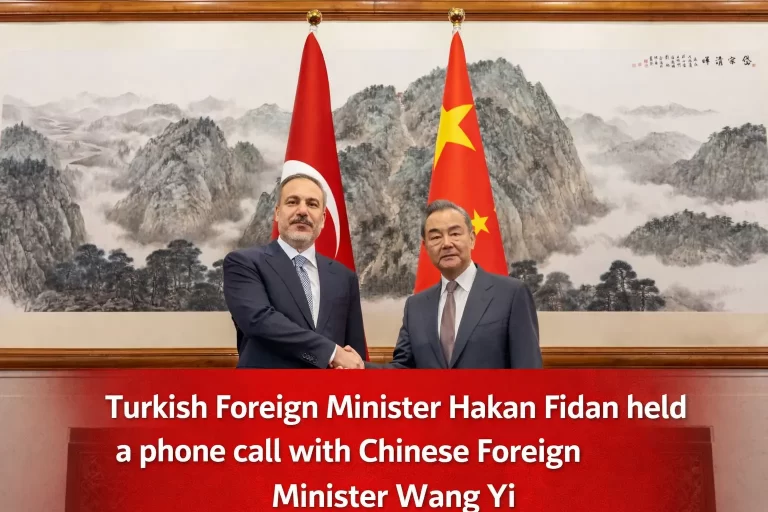
The third phase is from February 2019 to June 2024. The main characteristic of this phase is summarized by outsiders as “moving forward in doubt.” In February 2019, the spokesperson of Türkiye’s foreign ministry infuriated China’s governance policies in Xinjiang Uygur Autonomous Region, making Türkiye the first country in the Islamic world to issue remarks against China on Xinjiang-related issues, drawing international attention. It was not until Erdogan’s visit to China in July 2019 that relations between the two countries returned to normal. Since then, China and Türkiye have cooperated in the fight against COVID-19, and Erdogan has personally received a Chinese vaccine, significantly enhancing mutual trust between the two countries. In June 2024, Turkish Foreign Minister Hakan Fidan visited the Xinjiang Uygur Autonomous Region, which is the second visit by a senior Turkish government to China’s Xinjiang in 12 years.
The fourth phase runs from June to 2024. The main feature of the current development of bilateral relations is “steady progress and acceleration in multiple dimensions.” The heads of state of China and Türkiye have met frequently at multilateral diplomatic forums such as the SCO summit, which has pointed the direction for the development of bilateral relations. Meetings and mutual visits at the level of foreign ministers and vice ministers are equally frequent. In September 2024, Türkiye officially applied to join the BRICS cooperation mechanism, becoming the first NATO member country to apply to join the mechanism, which is highly symbolic.
Significant results have been achieved in many areas
In its Justice and Development Party’s (AKP) Political Vision 2023, released in 2012, the Turkish government proposed to transform Türkiye into an “energy hub” and a “geocentre” and to accelerates the middle corridor. The plan dovetails with the strategy of building the BRI. Against this background, relations between the two countries have achieved rapid development.
Economically, China has become Türkiye’s second largest trading partner and the largest trading partners in Asia, and is also the largest source of Turkish imports. The volume of trade between the two countries is gradually increasing, reaching $42.885 billion in 2024. The stock of Chinese direct investment in Türkiye has also increased significantly, and the prospects for bilateral production cooperation are broad. Chinese companies have carried out more and more investment and construction projects in Türkiye, buying up textile banks and the third largest container terminal, the Kumport. At the same time, the representative infrastructure projects of the Belt and Road cooperation such as the Ankara-Istanbul High-Speed Rail line and the Hunutlu Thermal Power Plant have successfully enhanced the image of Chinese companies in China. Financial cooperation between the two countries is also exemplary, such as the renewal of the bilateral currency swap agreement in June 2025, which expanded the size of the swap to 35 billion Yuan / 189 billion Turkish Lira.
Politically, under the guidance of the two heads of state, the strategic cooperative relationship between China and Türkiye have continued to develop. First, high-level exchanges are frequent. In August 2025, Turkish President Erdogan attended the SCO summit in Tianjin. On September 3, the Turkish Foreign Minister and Minister of Energy and Natural Resources attended the commemoration of the 80th anniversary of the victory of the Chinese People’s War of Resistance Against Japanese Aggression and the World Anti-Fascist War as special envoys of the President. These examples demonstrate the strong momentum of bilateral cooperation. Second, a high-level cooperation mechanism has been established. In 2015, the two countries established an intergovernmental cooperation committee mechanism to coordinate cooperation in political, economic, trade, security, and cultural fields. Third, Turkish leaders have generally expressed positive views on issues concerning China’s core interests. In July 2015, Erdogan stated that the Turkish government adheres to the one-China principle, firmly supports China’s sovereignty and territorial integrity, opposes terrorist acts against China such as the East Turkistan Islamic Movement, and will never allow the strategic cooperative relationship between Türkiye and China to be disrupted by destructive forces. In July 2019, during his visit to China, Erdogan stated, “It is a fact that people of all ethnic groups in Xinjiang, China, are living happily amidst China’s development and prosperity.”
Culturally, people-to-people exchanges between the two countries have continued to deepen and solidify. One is to hold a year of mutual culture and tourism. The Silk Road is a cultural bond that connects the two ancient and modern nations of Middle Eastern Europe. Thanks to a series of activities, the number of Chinese tourists to Türkiye in 2024 has increased to nearly 410 thousand, greatly promoting the understanding of the two peoples. The second is to establish friendly cities. At present, China and Türkiye have concluded 24 pairs of friendly cities, carrying out extensive cooperation and exchange in textile, business, culture, education, tourism and talent development. Third, mutual cultural research centres are established.At present, China has established four Confucius Institutes in Türkiye, and more than a dozen universities and some primary and secondary schools, such as the University of Ankara and the University of Istanbul, have opened Chinese language courses, and the Chinese language is becoming more and more popular among Turks.The Turkish side also established the Yunus Emre Turkish Cultural Center in Beijing. In addition, universities such as Peking University, Beijing Language University, and Shanghai University have gradually established Turkish research centers and jointly established the Turkish Research Consortium.
The potential for cooperation needs to be further unleashed
Compared with the escalating bilateral relations between China and Saudi Arabia, Iran, Egypt and other Middle Eastern countries in recent years, the potential of China-Türkiye cooperation still needs to be further unlocked.
First of all, the bilateral trade volume between China and Türkiye have been difficult to break the US $50 billion mark since 2010. At present, Türkiye’s exports to China mainly consist of raw materials and mainly imports machinery products from China, and its advantages in bilateral trade need to be further improved. Since 2018, the Turkish economy has faced severe challenges such as high inflation, high foreign debt and high government deficit. Although some analysts believe that the Turkish economic is resilient, some also say that the Türkiye has fallen into the “middle income trap,” which warrants the sustained attention of Chinese companies.
Secondly, the issue of counter-terrorism remains a core issue that is hampering the quality and upgrading of relations between the two countries. For China, this issue concerns national security and social stability, and concerns China’s core interests. No extra-regional force will be allowed to divide China or interfere in China’s internal affairs. Turkish President Recep Tayyip Erdogan also stated that he firmly opposes any activities in Türkiye that undermine China’s sovereignty and territorial integrity, and said he would cooperate with China in countering terrorism. If the Turkish side keeps its word, it will help cement the foundation of political mutual trust between the two countries. For Türkiye, since July 2015, when the Turkish government re-launched the military strike against the PKK, the impact of the Ukraine crisis, the changes in Syria and the Israeli-Iran conflict in recent years, the surrounding environment and domestic security situation of Türkiye have continued to be unstable, and its relations with Western countries have been alternately hot and cold. The Chinese government has always opposed all forms of terrorism, and whether the two sides can make greater breakthroughs on counter-terrorism in the future will be a major challenge to the development of China-Türkiye relations.
Third, on the whole, the populations of the two countries still know a limited amount about each other.In Türkiye, Sinology or Chinese Studies has achieved remarkable results since its establishment at the University of Ankara in 1935, but it still faces a shortage of teachers, difficulty in finding employment for students, and insufficient social and government support, which makes the supply of Chinese knowledge in Türkiye significantly inadequate. Although China has established a budding team of Turkish research scholars, due to language barriers and Western academic paradigms, it also faces an insufficient supply of relevant knowledge. There is an urgent need for China and Türkiye to change this situation through “localization” studies, which are currently promoted by regional country studies.
Explore prospects for bilateral relations
With regard to the aforementioned realities, I believe that China and Türkiye may explore ways to enhance bilateral relations by the following means. First, strengthen economic cooperation. At present, the most important task of the Turkish government is to develop the economy. In the March 2024 national local elections, Erdogan and the Justice and Development Party (AKP) suffered their “worst defeat” in more than 20 years in power in Türkiye. If Türkiye’s economy fails to improve significantly before a new election in 2028, Erdogan and the AKP will face serious challenges in their governance.
Second, we should vigorously develop local diplomacy. At present, most of the top six cities in Türkiye are dominated by the Republican People’s Party (CHP), the main opponent of the AKP, so strengthen exchanges between the existing friendly cities between China and Türkiye. Continuous exploration of more potential cities with different political party backgrounds in Türkiye, especially important cities such as Ankara, Izmir, Konya and Antalya on the Anatolian plateau, will help to promote China-Türkiye cooperation to a new level and enhance China’s overall image in Türkiye.
Third, military exchanges are conducted in moderation. Military exchange and cooperation is an important aspect of China-Türkiye strategic cooperative relations. As early as 2009, China participated in a Turkish air force hosted “The Anatolian Eagle ” The military exercises are also the first time China has held similar military drills with a NATO member state.
Fourth, deepen people-to-people exchanges and cooperation. An important reason for the lack of strategic mutual trust between China and Türkiye is the general lack of awareness of China among Turks. At present, there are very few books on Chinese history and contemporary China written by Turkish scholars. Due to Western influence, the information on China accepted by Turks is mostly old, one-sided and even false. Therefore, how to provide the Turks with the latest and most accurate information about China in a more acceptable way is an urgent problem for China-Türkiye people-to-people exchanges.
Over the past two hundred years, China-Türkiye relations have been based on “shared destiny” and “political equality.” When we entered this century, the “Chinese dream” and the “Turkish dream” met unexpectedly. In 2026, China and Türkiye will commemorate the 55th anniversary of the establishment of diplomatic relations. In the context of major changes unseen in the world in a century, if the bilateral relations can achieve greater development, it will be of great strategic significance to both China and Turkish.
Yang Chen is associate professor and director of the Center for Turkish Studies at Shanghai University
This article was originally published in Chinese on World Knowledge and has been translated into English with the author’s permission.
About the Author